
Last Updated on June 2, 2026 by Lexi Kisses
When humans don’t understand a concept they tend to fill in the blanks with mental shortcuts such as gender stereotypes as opposed to using strategies that are slower and more accurate.1
As a result they end up treating others based on preconceived notions rather than who they really are. This treatment leads to a society and system that subconsciously discriminates based on gender.
4 Ways Implicit Gender Biases Harm Us
Without a doubt, gender affects a lot of things. From life opportunities to social treatment. And, even though it might not be easy to pinpoint gender discrimination in our society; research shows that it is still alive and well.
Here are 4 ways gender biases are currently affecting our society.
Gender Biases Limit Your Possibilities
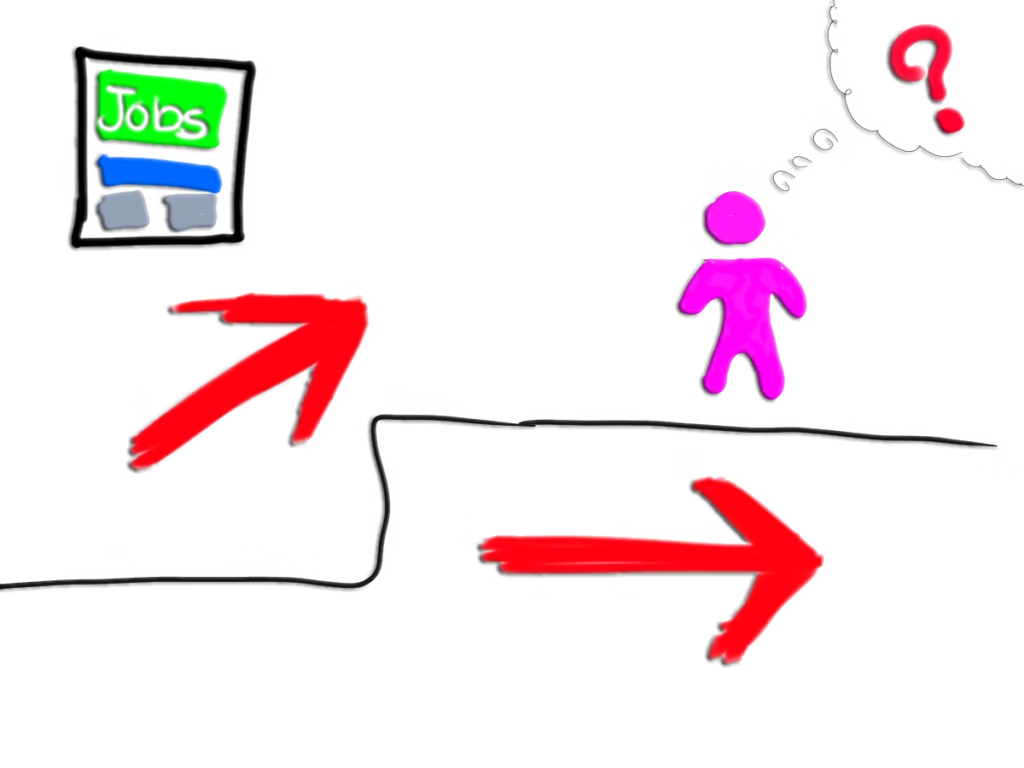
Being seen as a woman or man inherently affects the types of opportunities you receive.
A 1999 study published in Sex Roles: A Journey of Research sent 238 academic psychologists identical resumes with the names of the applicants changed to either a traditionally male name or female name.
The resumes with the “male” names were more likely to be picked by both female & male hirers despite them being exactly the same. In fact, some hirers even expressed that the male applicant had more adequate credentials.2
Apart from that, other studies show that even when a woman is hired; they are granted less growth opportunities,3 are more likely to be sexually harassed4, and are more likely to be disliked for being successful in male oriented fields.5
Similarly, white men were at a disadvantage when it came to jobs that were traditionally “female.” With hiring managers picking white women over white men (people of color had no advantages in these cases).6
In general, the effects of gender stereotypes disproportionately affect women as opposed to men. For this reason, women are more likely to be graded unfairly in school, 7 get less promotional opportunities 8, and are paid significantly less than their male peers in jobs after graduation 9
Their Harmful to Minorities

Besides being a woman, being a minority also sets you up for discrimination that is “justified” by gender stereotypes. For this reason minorities face the consequences of gender-based biases the most. With POC (people of color) and LGBT+ individuals being frequent targets.
When it comes to LGBT+ individuals, society weaponizes gender biases to confirm or deny someone’s gender identity. Research shows that if trans individuals don’t conform to the gender they were assigned at birth, there’s a high chance they will be discriminated against and victimized.10 11
Similar studies also reveal that gender biases harbor not only homophobic roots but racist ones. With a study from 2014 finding that Black men were less likely to be prescribed preventive HIV medications due to preconceived biases about them being more likely to engage in risky sex.12
Other studies show that college professors are more responsive to white males than minorities or females.13 Also, these studies don’t even factor in the day to day casual genderbased microaggressions that minorities are faced with.
They Promote Job Division

If the job you’re working at isn’t traditional to your gender, coworkers are more likely to default to stereotypes.
Research shows that being the only woman on a team contributes to more stereotypical characterization of women. This rise in gender characterization results in less women being hired and promoted in certain job fields.
This happens because inadequate representation does not expose others to differences and nuances. Which results in others perceiving “women” as a collective group as opposed to individuals (This did not apply to men).14
The job titles we use also contribute to these lack of opportunities. With data revealing that job titles affect what gender people think is best for the job (Police man, Waiter, Mailman).1 And that using gender-inclusive job titles contributes to less hiring bias (police officer, server, Mail Carrier).15
Their Damaging to Mental Health
Along with everything else, gender stereotypes are just toxic for your mental health, because they pave the way for gendered based micro-agressions.
Microaggressions are subtle, indirect, or unintentional statements, actions, or incidents that discriminate against minority groups.16 In this case, gender based microaggressions affect women, POCs and LGBT+ individuals the most.
Constantly being a victim of gender based microaggressions has negative effects on mental health. With many studies documenting the risks of long term exposure to subtle discrimination.
For instance, in the book Internalized Oppression: The Psychology of Marginalized Groups they discuss how long term exposure to microaggressions can result in a person internalizing these biases.17 Which results in internal hatred that manifests as a perceived lack of inferiority, substance abuse, and outward acts of violence.
A study conducted on moms and daughters found that moms who used these gender based microaggressions to raise their kids (ex: “act like a lady”) were more likely to have mental distress that was associated with depression, this also applied to their daughters.18
Not only that, but other research has found that being a frequent target of gender based microaggressions was associated with an increase in negative emotions. Which resulted in lower self esteem and substance abuse issues for many.19
Final Thoughts
We’re all individuals. Gender stereotypes simplify a concept that is anything but simple. Gender isn’t how you act, look or what you do. It’s just who you are.20 Weighing too hard on gender bias, can have harmful effects on you, others and society as a whole. Gender stereotypes do more harm than good.
But, as long as people think these stereotypes are facts; Women, POCs & LGBT+ individuals will face discrimination. So please, I encourage all of us to try to stay educated, question ourselves, question our system and work towards avoiding our unintended biases.
Get Started with a Free PDF on How to Avoid Unintended Biases
- Heilman, M. E., Caleo, S., & Manzi, F. (2024). Women at work: Pathways from gender stereotypes to gender bias and discrimination. Annual Review of Organizational Psychology and Organizational Behavior, 11, 165–192. https://doi.org/10.1146/annurev-orgpsych-110721-034105[↩][↩]
- Steinpreis, R.E., Anders, K.A. & Ritzke, D. The Impact of Gender on the Review of the Curricula Vitae of Job Applicants and Tenure Candidates: A National Empirical Study. Sex Roles 41, 509–528 (1999). https://doi.org/10.1023/A:1018839203698, https://www.academia.edu/8973992/The_Impact_of_Gender_on_the_Review_of_the_Curricula_Vitae_of_Job_Applicants_and_Tenure_Candidates_A_National_Empirical_Study[↩]
- Prakash, Jyoti et al. “Women and the workplace.” Industrial psychiatry journal vol. 33,2 (2024): 201-207. Doi: 10.4103/ipj.ipj_365_24[↩]
- Jagsi, Reshma, et al. “Sexual Harassment and Discrimination Experiences of Academic Medical Faculty.” JAMA, vol. 315, no. 19, 17 May 2016, p. 2120, jamanetwork.com/journals/jama/article-abstract/2521958, https://doi.org/10.1001/jama.2016.2188.[↩]
- Heilman, M. E., Wallen, A. S., Fuchs, D., & Tamkins, M. M. (2004). Penalties for Success: Reactions to Women Who Succeed at Male Gender-Typed Tasks. Journal of Applied Psychology, 89(3), 416–427. https://doi.org/10.1037/0021-9010.89.3.416[↩]
- Di Stasio, Valentina, and Edvard N. Larsen. “The Racialized and Gendered Workplace: Applying an Intersectional Lens to a Field Experiment on Hiring Discrimination in Five European Labor Markets.” Social Psychology Quarterly, vol. 83, no. 3, 3 July 2020, pp. 229–250, https://doi.org/10.1177/0190272520902994.[↩]
- Lavy, Victor, and Edith Sand. “On the Origins of Gender Gaps in Human Capital: Short- and Long-Term Consequences of Teachers’ Biases.” Journal of Public Economics, vol. 167, 1 Nov. 2018, pp. 263–279, https://www.nber.org/system/files/working_papers/w20909/w20909.pdf, https://doi.org/10.1016/j.jpubeco.2018.09.007. [↩]
- Roth, Philip L., et al. “A Meta-Analysis of Gender Group Differences for Measures of Job Performance in Field Studies.” Journal of Management, vol. 38, no. 2, 23 June 2010, pp. 719–739, https://doi.org/10.1177/0149206310374774.[↩]
- Jena, Anupam B., et al. “Sex Differences in Physician Salary in US Public Medical Schools.” JAMA Internal Medicine, vol. 176, no. 9, 1 Sept. 2016, p. 1294, jamanetwork.com/journals/jamainternalmedicine/fullarticle/2532788, https://doi.org/10.1001/jamainternmed.2016.3284[↩]
- Clements-Nolle, Kristen, et al. “Attempted Suicide among Transgender Persons.” Journal of Homosexuality, vol. 51, no. 3, 11 Oct. 2006, pp. 53–69, https://doi.org/10.1300/j082v51n03_04.[↩]
- Rood, Brian A., et al. “Predictors of Suicidal Ideation in a Statewide Sample of Transgender Individuals.” LGBT Health, vol. 2, no. 3, Sept. 2015, pp. 270–275, https://doi.org/10.1089/lgbt.2013.0048.[↩]
- Calabrese, Sarah K., et al. “The Impact of Patient Race on Clinical Decisions Related to Prescribing HIV Pre-Exposure Prophylaxis (PrEP): Assumptions about Sexual Risk Compensation and Implications for Access.” AIDS and Behavior, vol. 18, no. 2, 24 Dec. 2013, pp. 226–240, https://doi.org/10.1007/s10461-013-0675-x.[↩]
- Milkman, Katherine, et al. What Happens Before? A Field Experiment Exploring How Pay and Representation Differentially Shape Bias on the Pathway into Organizations. 2015. https://www.apa.org/pubs/journals/releases/apl-0000022.pdf[↩]
- Heilman, M. E., & Blader, S. L. (2001). Assuming preferential selection when the admissions policy is unknown: The effects of gender rarity. Journal of Applied Psychology, 86(2), 188–193. https://doi.org/10.1037/0021-9010.86.2.188[↩]
- Horvath, Lisa Kristina, and Sabine Sczesny. “Reducing Women’s Lack of Fit with Leadership Positions? Effects of the Wording of Job Advertisements.” European Journal of Work and Organizational Psychology, vol. 25, no. 2, 30 July 2015, pp. 316–328, https://www.researchgate.net/publication/279515531_Reducing_Women’s_Lack_of_Fit_with_Leadership_Effects_of_the_Wording_of_Job_Advertisements[↩]
- Merriam-Webster. “Definition of MICROAGGRESSION.” Merriam-Webster.com, 2019, www.merriam-webster.com/dictionary/microaggression.[↩]
- David, E. J. R., and Annie O. Derthick. What Is Internalized Oppression, and so What? Internalized Oppression, 1st ed., Springer Publishing Company, Dec. 2013, pp. 1–30, www.researchgate.net/publication/260125784_What_Is_Internalized_Oppression_and_So_What. Accessed 27 Feb. 2026.[↩]
- Feigt, Nicole D., et al. “The Impact of Gender‐Based Microaggressions and Internalized Sexism on Mental Health Outcomes: A Mother–Daughter Study.” Family Relations, vol. 71, no. 1, 18 Nov. 2021, https://doi.org/10.1111/fare.12622.[↩]
- Midgette, Allegra J., and Kelly Lynn Mulvey. “Unpacking Young Adults’ Experiences of Race- and Gender-Based Microaggressions.” Journal of Social and Personal Relationships, vol. 38, no. 4, 11 Feb. 2021, pp. 1350–1370, https://doi.org/10.1177/0265407521988947.[↩]
- Badgley, Jocelyn. “Disorders of Sex Development: Gender Is Not Chromosomal.” That’s Gender Dysphoria, FYI, genderdysphoria.fyi/en/chromosomes.[↩]



2 Comments on “Gender Stereotypes; You’re Right, They Do Affect Your Opportunities”